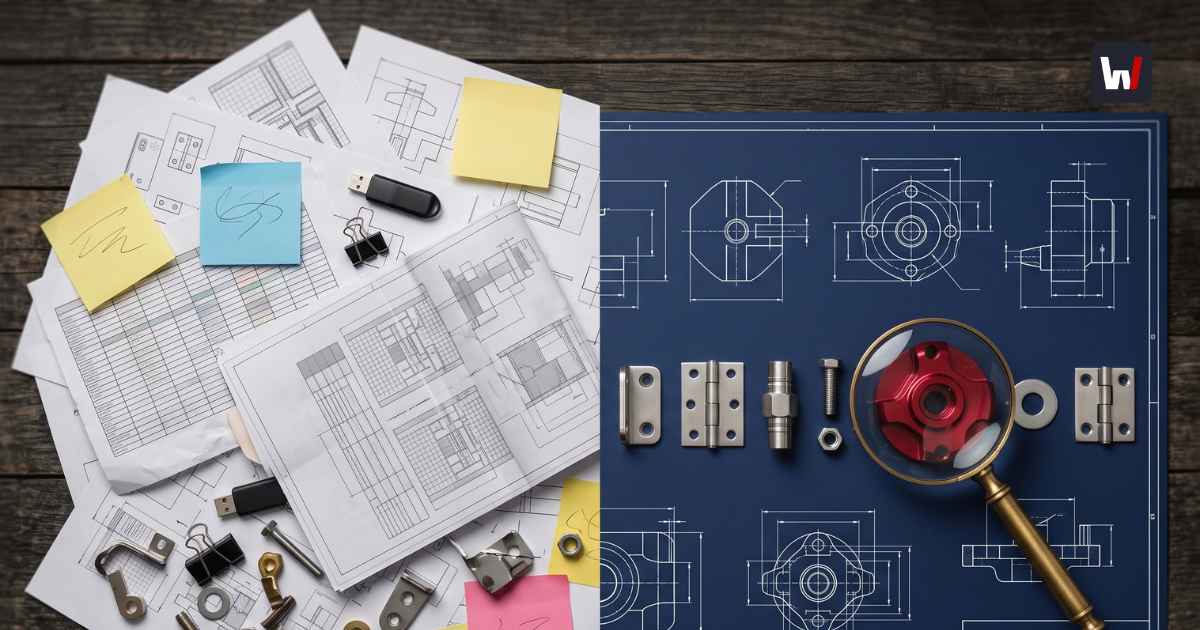
Manufacturers need a PIM (product information management) system because their product data is built by many teams, kept in many tools, and needed by many people in different formats. A PIM gives every product one approved version, so sales, distributors, and regulators all work from the same facts instead of their own favourite spreadsheet.
And in Europe, there's now a deadline too. New EU rules for construction products have applied since 8 January 2026, and the central Digital Product Passport Registry went live on 20 July 2026.
Messy product data used to be an internal problem. It's becoming a market access problem.
Key Takeaways
- Your product data has too many owners and no boss. Engineering, sales, marketing, and quality each hold a piece, and the pieces slowly drift apart.
- That drift costs deals. Quotes go out with old specs, distributors sell from outdated price lists, and engineers answer the same questions over and over.
- The warning signs are easy to spot. If a spec change takes days to reach every channel, or sales checks with engineering before every quote, you've outgrown spreadsheets.
- The EU is turning product data into a condition for selling. A PIM is the groundwork for the Digital Product Passport, and the EU registry is already live.
- Configurable products need rules, not just specs. A PIM that knows which options fit together can later run your quotes too, which is where sales finally meets production.
New to PIM? Our complete guide to PIM for manufacturing covers what it is and how it works. This one is about the why, and how to tell if you need one.
Why do manufacturers need a PIM? 5 problems it solves
Nobody wakes up wanting new software. Manufacturers buy a PIM when bad product data starts costing them time, deals, or margin. And since a manufacturer designs, builds, and certifies everything it sells, there's far more data to get wrong than in retail.
1. Your product data lives everywhere except one place
Specs sit in Excel, drawings in CAD, prices in the ERP, and certificates somewhere in someone's inbox. Each copy was right once, and each one drifts a little further from the truth with every change.
So when a customer asks for a datasheet, someone goes hunting for the latest version and then double-checks it with engineering, just in case. A PIM ends the hunt, because there's one approved record and every system reads from it.
2. Everyone owns a piece, nobody owns the product
Engineering owns the specs, marketing owns the descriptions, quality owns the certificates, and sales owns the price list. The product itself belongs to nobody in particular.
That's how a spec change reaches the website on Monday, the catalogue next month, and the distributor file maybe never. A PIM gives every field an owner, an approver, and a set moment when it goes live.
3. Quotes go out with yesterday's specs
A quote built on an old spec doesn't hurt when you send it. It hurts later, in production. In engineer-to-order manufacturing, 20-40% of quotes contain errors, and each one turns into a delay or rework.
With a PIM, sales quotes from the same specs, variants, and pricing rules that engineering and production use. The wall between sales and engineering gets a lot thinner. After our client Saku Metall moved its product data and quoting into one system, it made 80% fewer order errors.
4. Every channel wants its own format
Your website wants descriptions, images, and filters. Each distributor wants the price list in its own spreadsheet layout, naturally. Architects want 3D building files (BIM) they can drop straight into their project models.
Without a PIM, someone rebuilds each format by hand, and every new channel means more of it. With one, you enter the data once, and every export, feed, and connected tool pulls from that same record.
A PIM won't produce every format on its own, though. The distributor spreadsheet still needs an export set up for it, and the 3D building file still needs a tool that can generate one. The difference is that nobody retypes the data anymore.
5. The EU now wants your product data structured
The EU is moving product information out of PDFs and into machine-readable records, and it has put dates on it. These 3 matter most:
- 8 January 2026: the new Construction Products Regulation (EU) 2024/3110 started to apply. Product declarations now also cover environmental data, such as carbon footprint, which is being phased in.
- 20 July 2026: the EU's Digital Product Passport Registry went live. It will hold a unique ID for each product passport, from steel and furniture under the Ecodesign Regulation (EU) 2024/1781 to construction products.
- 18 February 2027: the first passports become mandatory, for certain large batteries. More product groups follow as the EU sets rules for each one.
If you make doors and windows, roof and facade systems, pipes and drainage, or prefab modules, this is about you: your products count as construction products under the CPR.
Every passport needs a unique product ID and structured data behind it. If your product data lives in spreadsheets, that's a multi-year cleanup before the real work starts. If it already lives in a PIM, most of the groundwork is done.
Does your company need a PIM? A quick check
Be honest with these 6. Every yes is a small tax you're already paying for running on spreadsheets.
- Does a spec change take more than a day to reach your website, price lists, and distributors?
- Does sales check product details with engineering before sending a quote?
- Is there more than one "master" spreadsheet for the same product range?
- Do you sell in several languages or countries?
- Do distributors or architects ask for product data in formats you build by hand?
- If a regulator asked for a structured record of every product you sell, would it ruin someone's month?
Several yeses? Then the next step is finding a PIM that stores the rules between products, not just their attributes. We compared 8 PIM platforms for manufacturing, including where each one falls short and what to ask in the demo.
Where Wabric fits
This is the part where we talk about ourselves, briefly. Wabric is a PIM built for manufacturers of configurable, engineered products, and it connects sales to production.
It keeps your technical attributes, compatibility rules, pricing logic, classification codes such as CCI, media, and certificates in one place. It syncs both ways with ERPs such as SAP, Odoo, Microsoft Dynamics, Directo, and Erply, and it remembers every change, so "who changed this?" finally has an answer.
PIM, CPQ (configure, price, quote), Partner Portal, and storefront all run on the same data model. Start with the PIM and add the rest when you're ready, with nothing to connect or keep in sync.
Add the CPQ later, and a confirmed configuration can come out as a priced quote, production-ready drawings, and a 3D building file (BIM) for the architect, all from the same data. Nobody redraws the order after the sale, and you can try the live demo to see how that works.
- Floorin, one of our clients, runs visual proposals across thousands of products from one centralised source.
- Saku Metall cut its sales cycle from 2 weeks to 2 hours, with 90-95% of orders now self-service.
- Industry recognition: the PIM behind Wabric, then called Wenture PIM, won Innovation Project of the Year 2024 from Estonia's Digital Construction Cluster.
One honest note: this isn't something you set up alone over a weekend. Our team builds the data model with you, so the PIM matches how your products are actually built and sold.
If any of this sounds familiar, see how the Wabric PIM works.
Summary
Manufacturers need a PIM because product data built by many teams drifts apart, and quotes, sales channels, and EU declarations all end up paying for it. A PIM gives each product one approved record that every system uses.
If you sell configurable products, choose a PIM that stores the rules between products, not just their specs. That's what lets the same data run your quotes, your partner orders, and your production drawings later.
Not sure you need one yet? Try a quick test before you talk to any vendor. Pick your most-quoted product family and list every place its data lives today, from spreadsheets and the ERP to CAD files and inboxes.
If the list runs long, or nobody can say who owns it, you've found the exact problem a PIM solves. And since mapping your data is where every PIM project starts anyway, the work isn't wasted.
Frequently Asked Questions
When product data starts slowing down sales. The usual signs are spec changes that take days to reach every channel, sales checking details with engineering before quoting, and more manual work with every new distributor or language.
Mostly time and errors. Quotes go out with outdated specs, orders need rework, and engineers answer questions the data should answer. Our client Innorel saved 80 sales engineer hours per month after moving its product data and quoting into Wabric.
No law says you have to buy a PIM. What the law wants is the data: once the rules for a product group apply, each product in it needs a Digital Product Passport registered with the EU. A PIM is the practical way to keep that data accurate across a full catalogue.
A Digital Product Passport needs a unique ID and structured data for each product, such as materials, attributes, and certificates. A well-structured PIM already holds most of it, so the passport becomes one more output instead of a new data project.
One person or team should own the product record as a whole, often product management. Engineering approves technical fields, and sales or finance approves prices. The PIM controls who can edit and approve each field.