Short answer: A railing configurator is a web tool where a customer, dealer or salesperson builds a railing in 3D and sees the price right away. For a manufacturer, the good ones do more. The same 3D model also makes the bill of materials, the production drawings and a BIM file, so nobody redraws the railing after the customer says yes.
It’s Tuesday afternoon. A customer emails you about a glass railing for their balcony. There’s a phone photo, a quick sketch and a short note: “Approx 7 metres, maybe 2 corners. Can you send a price this week?”
So the questions start. Which mounting type? Do the 7 metres include the corners? It takes 3 emails and a phone call to find out.
Then the only person who understands your Excel price sheet works it all out by hand. The quote goes out on Friday. On Monday, the customer says yes.
Great. Except now your drafter has to draw the whole railing again for the factory.
If you sell railings, this week probably sounds familiar. Let’s fix that!
This guide answers 4 questions. What does a railing configurator do? Does your company need one? Which one should you pick? And how do you start?
Key takeaways
What it is. A railing configurator lets customers, dealers and sales reps build a railing in 3D and see the price as they go.
Why railing quotes are slow. Every railing is different. Lengths, angles, glass, gates and local building rules all change the price. So most quotes are still made by hand.
What matters most. The value is in what you get after the customer clicks “confirm”. A good configurator makes the quote, the bill of materials and the drawings from the same 3D model. It can also make an IFC file for the architect.
Dealers can quote on their own. Give them their own login, their own prices and your rules, and they stop waiting for your team.
Real results. Innore saves about 80 hours a month per engineer. R-Fix quotes 60% faster with 80% less manual data entry.
Pick the right kind. There are CAD tools, ERP configurators, glass design tools, webshop configurators and CPQ. If you need the quote, the bill of materials and the drawings from the same model, plus dealer logins and an ERP link, you need CPQ.
Start small. Put your parts, prices and rules in one place. Then begin with 1 product family and your own sales team.
What is a railing configurator?
A railing configurator is software that lets someone build a railing in 3D in the browser and see the price right away. That someone can be your sales rep, your dealer or your customer. They pick the railing, type in the measurements and choose the details. The price changes as they go. You might also hear it called a 3D railing configurator, railing design software or a balustrade configurator.
Your rules are built into the model. They decide which glass works with which height, and which fittings go with which mounting. So a customer can’t order a railing your factory can’t make.
Some configurators are just a nice picture with a price tag. Others are a digital twin of your product. That means a working digital copy of your real railing, with real parts, real prices and real rules behind every option.
Wabric is the second kind. It’s a Europe-based CPQ and PIM platform for manufacturers of complex, made-to-order products. CPQ means configure, price, quote. PIM is where your product data lives. Wabric keeps that data in one place and turns each railing someone builds into a quote, a bill of materials and drawings.
2 railing manufacturers already quote this way. Innore makes balcony railings in Estonia and sells them in Norway and Sweden too. R-Fix makes glass railing systems and also sells them through dealers in Finland and Sweden. You may not know them, but their problems will sound familiar. You can even try R-Fix’s live configurator on our railing configurator page.
Why do railing quotes take so long?
Railing quotes take so long because every railing is a one-off. Lengths, angles, glass and local rules change on every project, and someone has to work out the price and the bill of materials by hand. Even a standard system becomes custom the moment it meets a real balcony.
Every railing is different
First, the shape: how long each side is, the angles and the corners. Then the product. Is the railing fixed on top of the slab or on its side? Glass panels or metal bars? Does the glass sit in front of the posts or behind them? Which handrail? Then the extras and the rules: gates, posts, fittings and the building rules of the country it goes to, like the minimum height.
And these choices depend on each other. The mounting decides which post you need. The glass decides which fittings you need. Change anything and the price, the bill of materials and the drawing all change too. That’s why custom railings outgrow a price list so fast.
Customers send half the details
Requests usually come by email. The drawing is missing things, or the details are wrong. So someone has to chase the customer before work can even start.
Someone works it all out by hand
Once the details are in, someone works out the price and the bill of materials by hand. Then an engineer checks it before the quote can go out. The prices are in the ERP or an Excel sheet. The rules are in someone’s head. If that person is on holiday, the quote waits.
At Innore, all of this added up to about 80 hours a month per engineer. That’s 2 full weeks of every month spent on quotes and drawings.
It’s slow. It’s annoying. And it’s stressful, because a wrong number doesn’t stay on paper. A wrong delivery to a building site costs real money.
With glass, small mistakes are expensive
Fun fact: toughened glass can’t be cut once it’s made. Try it and the whole pane breaks into tiny pieces. So a glass panel that shows up 10 mm too long can’t be fixed on site. It’s now a very expensive coaster. Every number in a glass railing quote has to be right before the glass goes into the furnace. That’s a lot of pressure to put on an Excel sheet.
How does a 3D railing configurator work?
A 3D railing configurator works in 5 steps: pick the railing, type in the measurements, choose the details, watch the price and confirm. When the customer confirms, it makes the quote, the bill of materials and the drawings from the same 3D model.
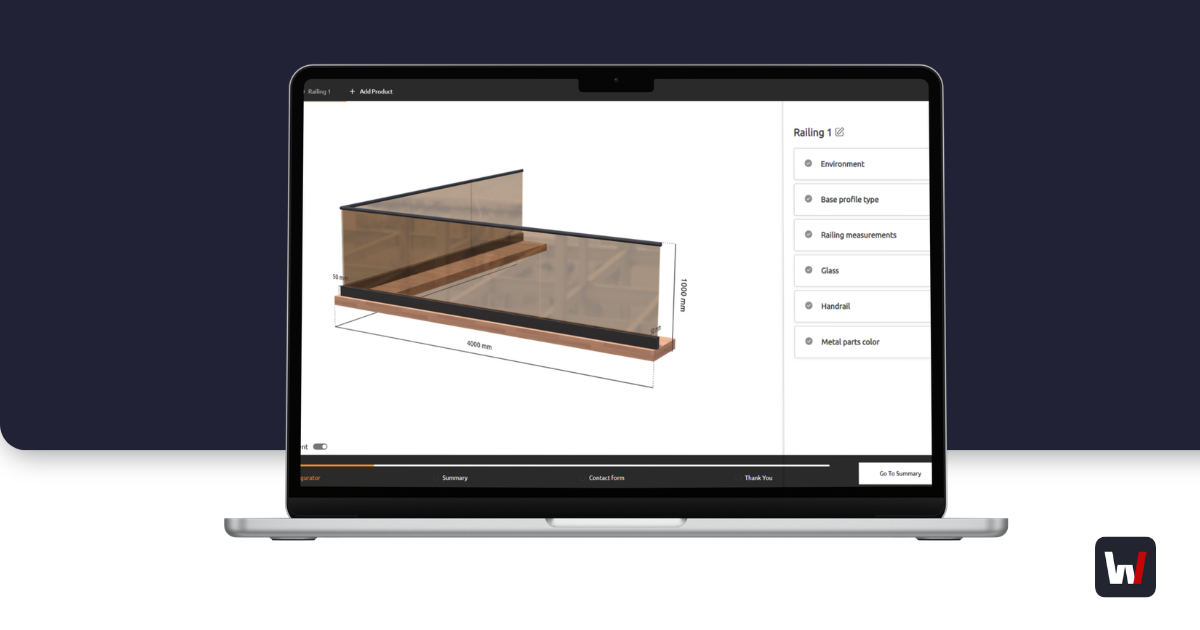
Step 1: Pick the railing. Your customer, dealer or sales rep picks the railing type and how it’s mounted, like top-mounted glass.
Step 2: Type in the real measurements. They set how long each side is, the angles and the corners. They add a gate where they need one.
Step 3: Choose the details. Glass, height, handrail and fittings. Your rules block anything you can’t make.
Step 4: Watch the price. Every change updates the 3D model, the price and the bill of materials at the same time. The prices come from your own data, in the local currency if you sell abroad.
Step 5: Confirm. The quote and the drawings come out of the same model. The order can go straight into your ERP.
What do you get when the customer clicks confirm?
You get a priced quote, a full bill of materials, drawings and a BIM file, all from the same model, plus the order itself.
A priced quote with a full bill of materials. Every part, counted and priced from your own data.
Drawings and a BIM file from the same model. 2D PDF drawings come out automatically. For production and BIM, Wabric can output DWG and IFC. Innore’s configurator, for example, makes an IFC model for every railing.
The order itself. Confirmed orders can go straight into your ERP, ready to check.
Why it matters that everything comes from the same model
Making everything from the same model is what ends the redrawing. The 3D model in Wabric isn’t just a picture. It’s parametric, which means it knows the real parts and the real rules.
In Wabric, the quote, the drawing and the BIM object come from the same model. So when a size changes, nobody redraws anything. You change the number and everything else follows.
How a confirmed quote becomes factory files: automated production drawings, from quote to CNC
Can architects use your railing in Revit or Archicad?
Yes. Architects can use your railing in Revit or Archicad when your configurator exports it as an IFC file. IFC is the open file format for BIM, the 3D building models with data in them that architects work in. No software company owns it, and it’s published by buildingSMART and as ISO 16739. Revit, Archicad and Tekla all work with IFC, so it’s how your railing gets from your configurator into the architect’s model.
For the architect, that means your exact railing, with the real height, glass and posts. Not a grey box with “railing” written on it. Your railing is in the project early, while decisions are still being made. Innore’s IFC models already open in tools like Dalux.
Not every railing order needs this. Plenty of balcony projects never touch a BIM model. But on the big projects that do, being the railing that’s already in the model is a very good place to be.
More on this: parametric BIM objects, where the quote builds the BIM object
How much time does a railing configurator save?
A railing configurator saved Innore about 80 hours a month per engineer. At R-Fix, it made quoting 60% faster and cut manual data entry by 80%. Here’s what changed.
Innore’s engineers got their time back. Remember those 2 weeks a month? Their sales engineers used to spend about half their time turning emailed drawings into quotes. Now customers build their own balcony railings in 3D, in Estonia, Norway and Sweden, with local prices and currencies. Norway’s building rules are built in, so a Norwegian railing is correct from the first click. Confirmed orders go straight into the ERP. The sales engineer checks and confirms instead of rebuilding the order from an email.

The result: about 80 hours saved per engineer every month, around 50% less time on quotes and no need to hire more salespeople.
Kristjan Igasta, co-founder and Engineering Manager at Innore, says the biggest value is the system behind the quotes. In his G2 review: “It removes the complexity of handling endless variations in product specifications and makes it possible to build a true digital sales engine”. He also names a downside: “What I like least is the limited flexibility to adjust the design and user interface myself.” Fair. Engineers are hard to impress.
R-Fix stopped waiting for engineers. They used to quote with email and Excel, and every quote waited for an engineer. Now sales reps make quotes themselves in the 3D configurator. The parts and live prices come from ERPLY, their ERP. Confirmed orders go back into ERPLY on their own.

The result: 60% faster quoting and 80% less manual data entry. Engineers stopped checking everyday quotes and went back to complex projects.
Read the full stories: how Innore quotes balcony railings in 3D and R-Fix’s 3D glass railing configurator. Want your own numbers? Try the ROI calculator.
Still quoting railings by email? Book a demo and bring a railing project you quoted recently. We’ll talk through how it would work in Wabric. Book a demo
Can your dealers order on their own?
Yes. Dealers can order railings on their own when the configurator gives each dealer their own login, their own prices and the same rules your sales team uses.
That’s how R-Fix works now. Its dealers in Finland and Sweden log in, build a railing, get a quote and send the order to the factory. Local business and private customers do the same. Before, every quote went through R-Fix’s own team, and the dealers’ customers had to wait too.
R-Fix’s next step is branded versions of the configurator, so its Finnish partners can sell the railings under their own name.
How dealer logins, access and prices work: the partner portal for manufacturers and distributors
Does your company need a railing configurator?
Your company needs a railing configurator if your orders are made to measure, quotes wait days for an engineer and your engineers lose hours on everyday quotes. If only 1 or 2 of the signs below fit, a better price list might be enough for now.
Every order is made to measure. Lengths, angles and heights change from project to project.
Quotes take days, not hours. They wait for an engineer or a drafter.
Your engineers lose hours on everyday quotes. At Innore, it was about 80 hours a month per engineer.
You sell through dealers or installers. And they wait for your team every time they need a price.
You sell abroad. Each country has its own rules, prices and currency.
Wrong orders cost you money. A railing that doesn’t fit means a second delivery, or a new glass panel.
Which railing software is right for you?
If you need the quote, the bill of materials and the factory drawings from the same model, plus dealer logins and an ERP link, pick a CPQ that also makes the factory files. If you only need nicer quotes, a simpler tool will do.
If you skipped straight here, fair enough. Here are the main options, from simplest to most complete.
Email and Excel
Email and Excel is where most manufacturers start, and it costs nothing to begin. But every price is worked out by hand. Nothing stops a railing you can’t make until an engineer checks it. The drawing gets drawn after the customer says yes. When a size changes, you start again.
CAD software with a railing tool
Some CAD programs have a railing tool that helps your drafter draw faster. But only the drafter uses it. Customers and dealers never see it, so every quote still starts with an email.
Your ERP’s configurator
Many ERPs have what’s called a variant configurator. It builds a correct bill of materials, which production loves. But it doesn’t give your customer a 3D view or a quote to approve, and it usually doesn’t make the drawing. Here’s how an ERP configurator differs from CPQ.
Glass design software for glaziers
Glass design software is made for glaziers and installers who design and quote glass railings, often with hardware from suppliers. It’s quick for glass drawings and quotes. If you make your own system, check that it can hold your own parts, rules and prices, and that it works with your ERP.
A 3D webshop configurator
A 3D webshop configurator is made to show and sell a product online, with a 3D view and live prices. Ask if it also makes the bill of materials and the production drawing, or only the picture and the price. Often the price updates when a size changes, but the drawing doesn’t.
CPQ that also makes the factory files
A CPQ that also makes the factory files is made for manufacturers. The quote, the bill of materials, the drawings and the IFC file all come from the same model. Dealers get their own logins and prices, and orders go straight into your ERP. When a size changes, everything updates. Wabric is this kind.
How do you set up a railing configurator?
To set up a railing configurator, get your parts, prices and rules into one place, then start with 1 product family and your own sales team. After that, open it to dealers and customers and connect your ERP. You bring the product knowledge, and the vendor builds the model with you.
Get your data ready
A configurator can only be as good as the parts, prices and rules behind it.
Your systems and options. List the railing systems you sell and the options customers really choose.
Your parts and prices in one place. Every post, fitting and glass type, with cost and sales prices. In Wabric, this lives in the PIM. Innore keeps its cost, list and resale prices there.
Your rules, written down. What goes with what, what you can’t make and what changes from country to country. If the rules only live in an engineer’s head, now is the time to write them down.
What it needs to make. A quote and a bill of materials, always. Drawings for your factory. An IFC file if you sell into big building projects.
Start small, then grow
Start with 1 product family. Pick the railing system that gets the most quote requests. Get it right, then add the next one. R-Fix started with its glass railings and is now adding new product groups.
Let your sales team test it first. They know the product and will spot a wrong rule fast. Once they trust the prices, the next steps are easier.
Then open it to dealers and customers. Each dealer gets a login and their own prices. Customers get the 3D view on your website. R-Fix’s dealers in Finland and Sweden now order this way, and Innore’s customers build their own railings.
Connect your ERP. Orders go straight in, so nobody types them again. Innore’s orders land in its ERP, and R-Fix also gets live prices from ERPLY.
Keep the data in your hands. Make sure your own team can change products and prices without calling the vendor. R-Fix’s next step is to manage all its own product data, rules and 3D models.
What a configurator won’t do
A configurator won’t clean up messy data for you. It won’t replace your engineers on true one-off projects either. It takes the everyday quotes off their desks, so they have time for those.
Why the data comes first: why you need a PIM before building a configurator
What should you ask before you buy?
Before you buy a railing configurator, ask what you get after the customer clicks confirm. Most demos start with a nice 3D railing, and these 8 questions get you to the part that matters.
1. Does a confirmed quote give my factory a DWG? You want CAD drawings made straight from the railing the customer built, not a PDF someone redraws.
2. Can it export an IFC file an architect can open? That’s how your railings get into bigger building projects.
3. When a customer changes a size, who redraws? The right answer is nobody. If it’s “our team”, the redrawing just moved to someone else’s desk.
4. Where do the prices come from? From your own data, best of all live from your ERP. Not from a copy someone updates when they remember.
5. Can dealers order on their own? Each dealer needs a login, their own prices and your rules.
6. Are our rules built in? Glass, fittings and country rules should live inside the model, so nobody can order a railing you can’t make.
7. Can our own team change products and prices? A new glass colour, a new price list. If each one needs a call to the vendor, you’ll feel it.
8. Do they understand how railings are built? Ask how the mounting changes the post, or how the glass changes the fittings. If they can’t answer, you’ll get a nice picture, not a working model.
How to judge a configurator demo: why configurator projects stall, and how to evaluate one properly
What do CPQ, PIM, BOM, DWG and IFC mean?
CPQ turns a configured product into a priced quote. PIM holds your product data, a BOM covers every part, DWG is the CAD drawing format and IFC is the open file format for building models.
Railing configurator: software that lets someone build a railing in 3D and see the price right away.
CPQ (configure, price, quote): software that turns a configured product into a priced quote.
PIM (product information management): the place where all your product data lives, like parts, prices, rules and images.
Bill of materials (BOM): every part needed to build the railing, with how many of each.
Parametric model: a 3D model that knows the real parts and rules, so it updates itself when a size changes.
Digital twin: a working digital copy of your real product, with real parts, prices and rules behind it.
DWG: the CAD file format drafters and factories use for production drawings.
IFC: the open file format for building models. Architects use it to bring products into Revit, Archicad or Tekla.
BIM (building information modelling): a 3D building model with data in it, used by architects and engineers to plan a building.
Variant configurator: a tool inside an ERP that builds a correct bill of materials, but without a 3D view or a quote for the customer.
Summary
Railing quotes are slow because every railing is a one-off. Even in 2026, most of the work happens by hand, from the first email to the redraw after the customer says yes.
A railing configurator fixes the start of that. Customers, dealers and sales reps build the railing in 3D and see the price right away. The good ones fix the end too. The quote, the bill of materials, the drawings and the IFC file all come from the same model.
That’s how Innore saves about 80 hours a month per engineer, and how R-Fix quotes 60% faster. Choosing one? Pick the kind that gives your factory what it needs. Get your data in order and start with 1 product family. Then ask every vendor what you get after the customer clicks “confirm”.
Want to see how it would work for your railings? Book a demo and tell us how your railing system is built. We’ll talk through which parts of Wabric fit, from the 3D model to the drawing your factory gets. Book a demo
Bring that email thread too. The one that says “approx”.
Frequently Asked Questions
Yes. Balustrade and railing mean the same thing, so the tools do the same job. A glass railing configurator is the same tool with extra rules for glass, because toughened glass can’t be cut once it’s made.
Yes. Wabric builds configurators for metal and glass products like railings, gates, stairs, facades and fences. It just needs your real parts and rules.
A railing configurator is the part where someone builds the railing in 3D. CPQ (configure, price, quote) is the whole system behind it: the rules, the prices and the quote. Wabric is a CPQ that can also make the drawings and the BIM file from the same model.
Right away, if you use a railing configurator. The price updates while the customer clicks, and the quote is ready when they finish. At glass railing manufacturer R-Fix, every quote comes with 2D drawings, and sales reps quote 60% faster than before.
No. It takes the everyday quotes and redrawing off their desks. Your engineers still handle the special projects, which is where you need them most.
A good one does, both ways. Prices and parts come in from your ERP, and confirmed orders go back out. So nobody types an order twice.